 HY
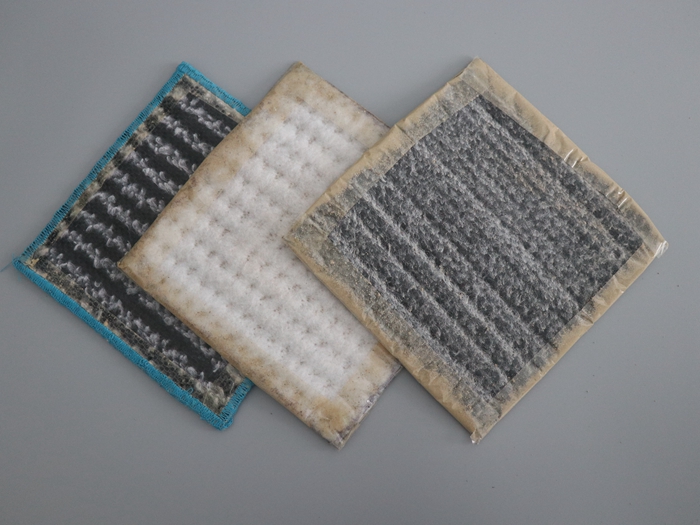
HYSodium bentonite geosynthetic clay liner to JG/T 193-2006. Swells on wetting to form a low-permeability gel and self-seals punctures up to ~20 mm.
Manufacturer: Shandong Hengyang New Materials Co., Ltd. | Standards as cited belowOverview
- Standard
- JG/T 193-2006 (refer also JC/T 2054-2020)
- Bentonite
- Natural sodium bentonite, swell index commonly ≥24 mL/2g
- Loading
- 4000–6000 g/m² typical
- Width
- 2–6 m
About Bentonite Waterproof Mat (GCL)
GCL sandwiches sodium bentonite between two geotextiles. On wetting under confining load the bentonite swells into a dense low-permeability gel, and its self-healing ability can close punctures around 20 mm—something a membrane cannot do.
GCL requires confinement from an overlying load to work, and must be kept dry before installation. In high-containment works it is combined with an HDPE membrane as a composite liner: GCL as the auxiliary layer, membrane as the primary barrier.
Key Specifications
- Standard
- JG/T 193-2006 (refer also JC/T 2054-2020)
- Bentonite
- Natural sodium bentonite, swell index commonly ≥24 mL/2g
- Loading
- 4000–6000 g/m² typical
- Width
- 2–6 m
Typical Applications
Landfill auxiliary liner
Decorative and landscape lakes
Basement and underground waterproofing
Canal and reservoir lining
Frequently Asked Questions
GCL or HDPE membrane?
They complement each other. Membrane gives a defined high-performance barrier; GCL adds self-healing and deformation tolerance. High-containment projects use both as a composite liner. For landscape lakes GCL alone is often sufficient.
Can it be installed in rain?
No. Bentonite hydrates on contact with free water and loses the swelling pressure it needs under confinement. Keep it covered and install only in dry conditions.
Enquiry | Bentonite Waterproof Mat (GCL)
Send your specification, quantity, required standard and destination to receive selection advice and a quotation. Samples and mill test reports available.