 HY
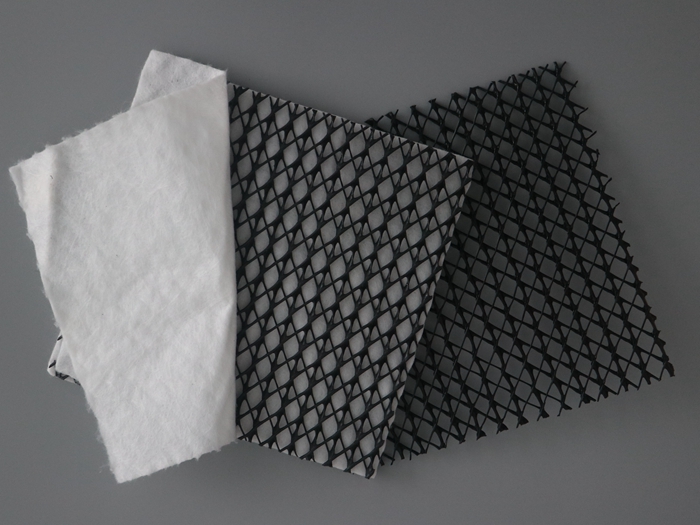
HYTwo-rib or three-dimensional drainage net with bonded geotextile for filtration. Landfills to CJ/T 452-2014; highways to JT/T 1432.4-2023.
Manufacturer: Shandong Hengyang New Materials Co., Ltd. | Standards as cited belowOverview
- Standards
- CJ/T 452-2014 (landfill) · JT/T 1432.4-2023 (highway)
- Core
- Two-rib or three-dimensional HDPE
- Thickness
- 4–8 mm core
- Width
- 2–6 m
About Drainage Geocomposite
Drainage geocomposite combines a polymer drainage core with geotextile filters: the core provides continuous drainage channels while the fabric admits water but blocks soil and waste fines that would clog the channels.
At only a few millimetres thick it can replace a 300 mm gravel drainage layer, greatly reducing load on the liner below and shortening construction time. Transmissivity must be verified at the design normal stress.
Key Specifications
- Standards
- CJ/T 452-2014 (landfill) · JT/T 1432.4-2023 (highway)
- Core
- Two-rib or three-dimensional HDPE
- Thickness
- 4–8 mm core
- Width
- 2–6 m
Typical Applications
Landfill leachate collection
Sub-liner groundwater drainage
Closure cover infiltration drainage
Road and rail subgrade drainage
Frequently Asked Questions
Two-rib or three-dimensional?
Three-dimensional cores carry higher normal stress and give higher transmissivity—used for landfill leachate and closure drainage. Two-rib suits lighter road and slope drainage.
Can it replace gravel?
Yes where the design confirms transmissivity at the actual normal stress, long-term anti-clogging performance, and a reliable connection to the collection pipe system.
Enquiry | Drainage Geocomposite
Send your specification, quantity, required standard and destination to receive selection advice and a quotation. Samples and mill test reports available.